Lobster Bisque
The shells are the recipe. They are roasted, simmered into a stock, and that stock is reduced hard before any cream appears — which is why this tastes of lobster rather than of cream with lobster in it.
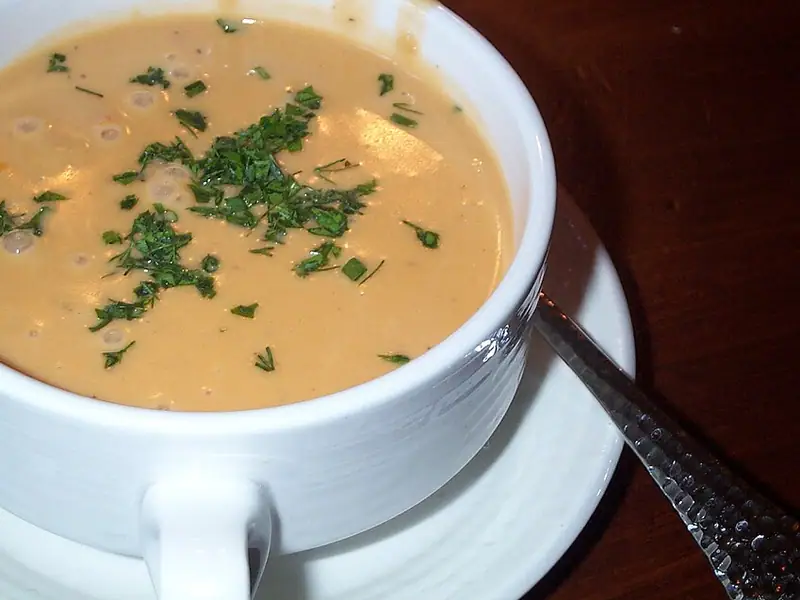
Photograph credit: Lobster bisque by Stu Spivack · CC BY-SA 2.0 · Wikimedia Commons · this resized copy is shared under the same licence
Almost all the flavour of a lobster is in the shell, not the meat, and it is released by two things: roasting, which browns the proteins and sugars in the shell, and simmering, which extracts them. Everything else is technique in service of that. The brandy is flamed to burn off raw alcohol while keeping the aromatics; the tomato purée is cooked until it darkens for depth; and the whole thing is reduced by a third before the cream, because adding cream to an under-reduced stock gives you a soup you cannot fix without curdling it.
How to Make Lobster Bisque
Tap a step to highlight it, or turn on Cook Mode for large type and step-by-step focus.
-
Heat the oven to 220°C / 425°F. Break the shells up roughly, spread them on a tray and roast 20 minutes until deep red and fragrant.
-
While the shells roast, melt the butter with the oil in a large pot and cook the onion, carrot, celery and fennel over medium heat for 12 minutes until soft and golden.
-
Add the garlic for 1 minute, then the tomato purée, and cook 3 minutes until it darkens to brick red.
-
Add the roasted shells and stir to coat.
-
Pour in the brandy, stand back, and let it bubble hard for 2 minutes until the raw alcohol smell has gone.
-
Add the wine and reduce by half, then the stock, bay, tarragon, peppercorns and rice.
-
Simmer, uncovered, for 45 minutes — the liquid should reduce by about a third and the rice should be completely collapsed.
-
Fish out the largest shell pieces and the bay leaves, then blend the rest in batches until as smooth as your blender will manage.
-
Pass through a fine sieve, pressing hard on the solids with a ladle, and discard what will not go through. Do this twice for a truly silky bisque.
-
Return to a clean pan, stir in the cream, salt, cayenne and lemon juice, and warm through without boiling. Serve with the lobster meat warmed in a little butter and divided between the bowls.
Related guide: Choosing rice.
Something wrong or unclear in this recipe? Report a problem with this recipe.
Worth Getting Right
- The rice is the thickener. It disappears completely and leaves body without flour.
- Sieve twice. The first pass takes out the shell, the second takes out the grit you can feel but not see.
- Never boil after the cream. It splits and there is no way back.
Common Substitutions & Variations
- In a sauce, full-fat crème fraîche can usually take the place of the double cream; single cream is thinner and more likely to split if it boils, so keep it below a simmer.
- An eighth of a teaspoon of garlic powder per clove is the stand-in usually given when you are out of fresh garlic; it will not brown the same way, and it burns easily, so add it with the liquid.
- A dry vermouth keeps for longer than an open bottle of white wine and is the closer swap than a random white left in the fridge; for an alcohol-free version, use the same amount of stock with a squeeze of lemon.
What to Serve With It
A glass of white Burgundy · Crusty bread and salted butter · A dry sherry as an aperitif
Sides from the same cuisine on this site: French Baguette, Fougasse, Pain aux Noix.
Leftovers and Storage
The bisque base, before the cream, keeps 3 days refrigerated and freezes for 3 months. Add the cream on reheating.
What's in a Serving
Per serving, an approximate calculation from the ingredient list. Treat it as a rough guide: all the alcohol is counted, though some is lost in cooking. The calories include 13 g of alcohol a serving, which is not part of the protein, carbohydrate or fat. How the figures are worked out.
Your notes on this recipe
Cooked this? Keep a note for next time
Compiled by Turab
Checked by script for timings, diet labels and nutrition arithmetic. How the recipes are checked. Found a mistake? Tell us.
First published ; last changed .
You Might Also Like
More French cooking and dinner ideas from Weekly Delight.

Rôti de Porc au Lait
A pork roast simmered for 90 minutes in milk with garlic and sage until the milk curdles into a nutty, golden sauce.
Sole with Grapes
Sole fillets poached in a light sauce of shallot, unsalted stock and lemon with warm green grapes and tarragon. Four…
Quenelles de Brochet
Pike beaten with choux paste into weightless dumplings, poached and baked in a crayfish sauce. Lyon, and one of the…
Poulet Basquaise
Chicken braised with peppers, tomato and piment d'Espelette from the Basque country. The peppers are cooked down to…
Coq au Vin
Chicken braised in red wine with lardons, mushrooms and pearl onions — the rustic cousin of bourguignon, and faster…

Lapin a la Moutarde
Rabbit pieces browned and braised for 60 minutes in white wine, Dijon mustard and cream, until the meat is tender…