Butter Croissants
Genuinely laminated croissants with a honeycomb interior and a shattering shell — 27 layers of butter folded into dough over two days. It is a project, but the technique is entirely learnable and the result is unbuyable outside France.

Photograph credit: Apricot croissant - Caffè Nero 2024-12-12 by Andy Li · CC0 · Wikimedia Commons
Don't Make These Mistakes
Work in the coolest part of your kitchen and return the dough to the fridge the moment it starts to feel soft.
Butter with at least 82% fat content is essential; standard butter carries too much water and will steam the layers apart.
If butter leaks out during baking, the proof was too warm. The croissants will still be good, just less airy.
Cooking Butter Croissants
Tap a step to highlight it, or turn on Cook Mode for large type and step-by-step focus.
-
Mix the dough ingredients to a smooth, firm dough — 5 minutes in a mixer or 8 by hand. Shape into a 20 cm square, wrap, and refrigerate overnight.
-
Pound the cold butter between two sheets of baking paper into an even 18 cm square. Keep it cold and pliable, like firm modelling clay.
-
Roll the dough into a 20 x 40 cm rectangle. Lay the butter block on one half and fold the other over, sealing the edges by pinching firmly.
-
Roll out to 20 x 60 cm, working lengthwise with firm, even pressure. Fold in thirds like a letter. Wrap and chill 45 minutes.
-
Repeat the roll and letter fold twice more, chilling 45 minutes between each. Three folds gives you 27 butter layers.
-
Roll the final dough to 30 x 60 cm and 4 mm thick. Trim the edges square — sealed edges cannot rise.
-
Cut into triangles with a 12 cm base. Notch the centre of each base, stretch gently, and roll up from base to tip without compressing.
-
Arrange on lined trays, tip tucked underneath. Prove at 24 to 26°C / 75 to 79°F for 2 to 3 hours until visibly jiggly and roughly doubled — do not prove them warmer, or the butter will melt out.
-
Brush carefully with egg wash, avoiding the cut layers. Bake at 200°C / 390°F for 18 to 20 minutes until deep mahogany. Cool on a rack for 20 minutes before eating.
Related guide: Prep, cook and total time.
Something wrong or unclear in this recipe? Report a problem with this recipe.
Why It Works
Lamination works by keeping butter as continuous solid sheets between dough layers; in the oven, water in the butter turns to steam and forces those layers apart. Everything therefore depends on temperature — butter warmer than 16°C / 60°F smears into the dough and the layers merge, while butter colder than 12°C / 55°F cracks and tears them.
Leftovers, Reheating and Keeping
Best within hours of baking. Keep 2 days in a paper bag and refresh at 180°C / 355°F for 5 minutes. Freeze shaped, unproven croissants for 1 month — prove from frozen for 4 to 5 hours.
What to Serve Alongside
- Café crème or a bowl of hot chocolate
- Serve with apricot jam and salted butter
- Excellent split and filled with ham and Gruyère the next day
Questions and Answers
How long does Butter Croissants take to make?
3 hours of preparation and 20 minutes of cooking, plus 11 hours 50 minutes to 12 hours 50 minutes of chilling and proving, so allow 15 hours 10 minutes to 16 hours 10 minutes from start to finish. The recipe serves 8.
What's in a Serving
Per serving, calculated from the ingredient list with USDA FoodData Central figures (SR Legacy). A calculation, not a laboratory analysis: brands, cuts and how you measure change the real numbers. How the figures are worked out.
Your notes on this recipe
Cooked this? Keep a note for next time
Compiled by Turab
Checked by script for timings, diet labels and nutrition arithmetic. How the recipes are checked. Found a mistake? Tell us.
First published ; last changed .
You Might Also Like
More French cooking and baking ideas from Weekly Delight.

Chouquettes
Small choux buns rolled in pearl sugar and baked empty. Sold by weight in paper bags and eaten before you get home.

Langues de Chat
Thin, crisp, finger-shaped butter biscuits made from a soft batter piped into long strips and baked for 10 minutes.

Madeleines
Proust's shell-shaped tea cakes, with the crisp browned edge and the hump on the back that tells you the batter was…

Almond Croissant
Day-old croissants soaked in sugar syrup, filled with almond cream and topped with flaked almonds, baked until golden.
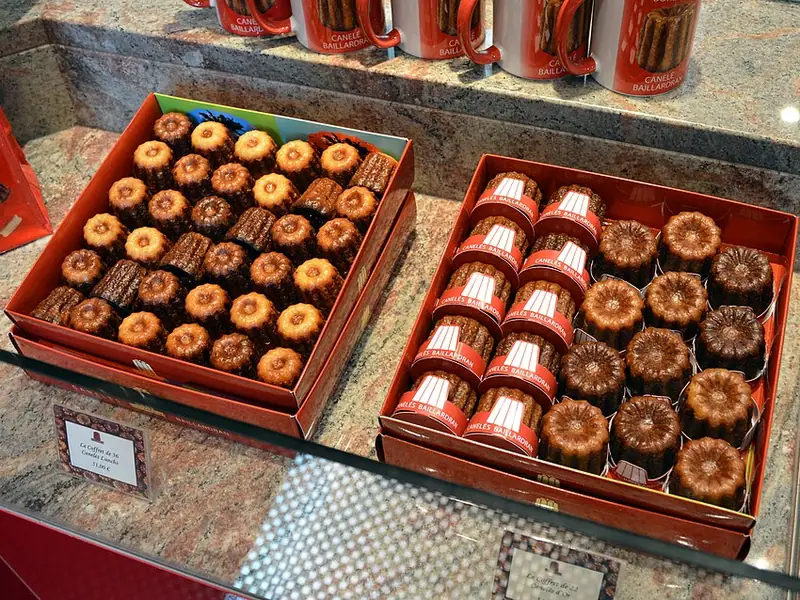
Canelés de Bordeaux
A Bordeaux pastry with a black, almost burnt caramel shell and a soft, custardy centre shot through with rum and…


Gateau Breton
A thick, buttery, golden cake with a crisp edge and a soft centre, scored with a lattice and baked for 40 minutes.