Kombucha
Sweet tea fermented by a culture into something sour and lightly fizzy, then bottled with fruit for a second ferment that carbonates it. Eight days, most of them unattended.
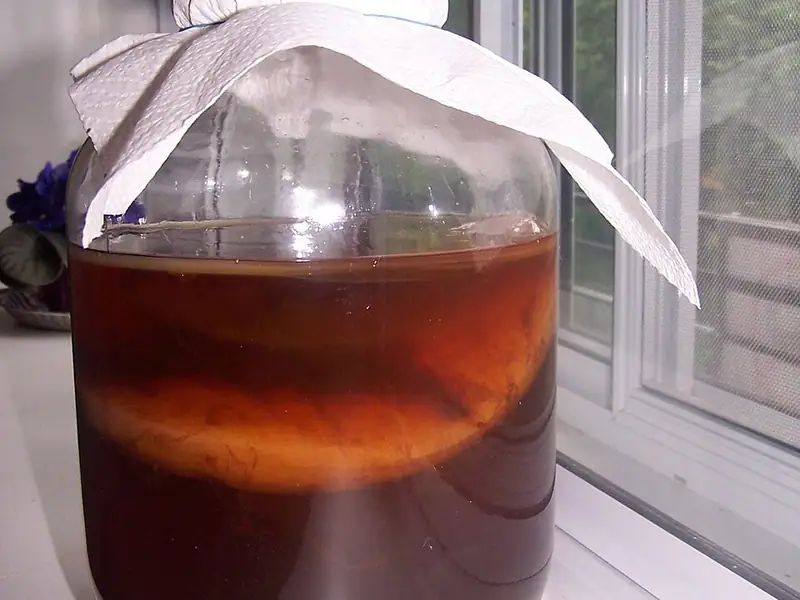
Photograph credit: Kombucha jar by Romarin · Public domain · Wikimedia Commons
Storing and Planning Ahead
Refrigerated for a month; the fizz fades slowly. The SCOBY keeps indefinitely in a jar of finished kombucha.
Kombucha: The Method
Tap a step to highlight it, or turn on Cook Mode for large type and step-by-step focus.
-
Bring 1 litre of the water to a boil, take it off the heat, add the tea and steep 10 minutes.
-
Remove the tea, stir in the sugar until dissolved, then add the remaining 1 litre of cold water.
-
Let it cool to room temperature completely. Hot liquid will kill the culture, so check it with a finger rather than guessing.
-
Pour into a clean 3 litre glass jar, add the starter liquid and slide the SCOBY in on top.
-
Cover the mouth with a tight-woven cloth secured with a rubber band — it needs air but not fruit flies — and leave somewhere warm and dark, 20 to 26°C / 68 to 79°F.
-
Leave 7 days, then taste through a straw pushed past the SCOBY. It should be pleasantly sour with only a trace of sweetness. Give it another day or two if it is still sweet.
-
Lift the SCOBY out into a clean bowl with 200 ml of the liquid, ready for the next batch.
-
Divide the fruit between four swing-top bottles, fill with kombucha leaving 4 cm of headspace, and seal.
-
Leave at room temperature 2 to 3 days, opening one bottle each day to check the fizz. Refrigerate as soon as it is carbonated — this stops the ferment.
Related guide: Prep, cook and total time.
Something wrong or unclear in this recipe? Report a problem with this recipe.
A Few Pointers
- Glass and plastic only, never metal, and no antibacterial soap anywhere near it. Both harm the culture.
- "Burp" the bottles daily. A forgotten second ferment in a warm kitchen can build enough pressure to break the bottle.
- A brown, stringy growth hanging off the SCOBY is yeast and is normal. Fuzzy blue or green spots are mould — throw the whole batch away and start again.
Why the Method Is What It Is
The culture — a colony of yeast and acetic acid bacteria — eats the sugar and produces acid, so the sweetness you start with is fuel rather than flavour, and a kombucha fermented long enough is not sweet at all. The first ferment is open to the air because the bacteria need oxygen; the second is sealed, so the carbon dioxide the yeast produces has nowhere to go and dissolves into the liquid. That is the entire difference between flat kombucha and fizzy kombucha.
Good Alongside
A hot afternoon · Rich food · Instead of a beer
Ingredient Swaps
- If you only have ground ginger, a quarter-teaspoon for each tablespoon of fresh is the ratio usually given; it tastes warmer and less bright than the fresh root.
Kombucha FAQ
How long does Kombucha take to make?
20 minutes of preparation and 15 minutes of cooking, plus 1 week to 1 week of fermenting, so allow 1 week to 1 week from start to finish. The method also needs time for cooling to room temperature, which it does not time, so treat that as a minimum. The recipe serves 8.
What's in a Serving
No nutrition figures are given for this recipe: they cannot be worked out reliably from its ingredient list (some ingredient lines cannot be read). Why some recipes have none.
Your notes on this recipe
Cooked this? Keep a note for next time
Compiled by Turab
Checked by script for timings, diet labels and nutrition arithmetic. How the recipes are checked. Found a mistake? Tell us.
First published ; last changed .
You Might Also Like
More International cooking and drinks ideas from Weekly Delight.

Fruit Smoothie
Frozen strawberries and mango, a ripe banana, yoghurt and orange juice blended into a thick, cold, pink smoothie…

Brown Sugar Bubble Tea
Black tea and milk over chewy tapioca pearls cooked and steeped in sugar syrup. Invented in Taiwan in the 1980s, and…
Mulled Wine
Red wine warmed with citrus, sugar and whole spices, never allowed to boil. A European winter market fixture, and…

Dark and Stormy
Spicy ginger beer topped with a float of dark rum and a squeeze of lime, poured over ice. Bermuda's national drink…

Green Smoothie
Baby spinach, banana, frozen pineapple, cucumber, ginger and lime blended with coconut water into a bright green…


Golden Milk
Warm milk simmered with turmeric, cinnamon, ginger and black pepper and sweetened with honey. The bright yellow…