Injera
The sour Ethiopian flatbread that doubles as plate and cutlery. Teff flour and water, fermented for three days until it bubbles, then cooked on one side only so the surface stays full of holes.
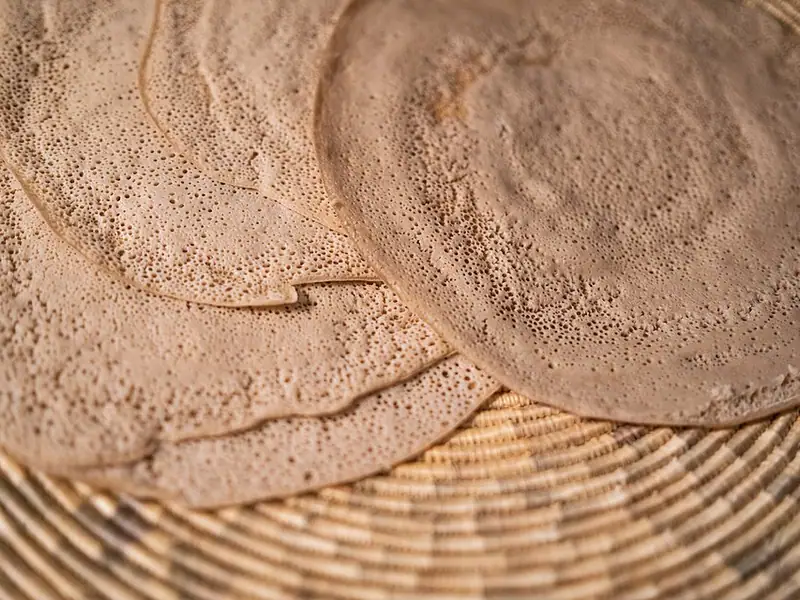
Photograph credit: Injera from ivory teff by Edsel Little · CC BY-SA 2.0 · Wikimedia Commons · this resized copy is shared under the same licence
Method
Tap a step to highlight it, or turn on Cook Mode for large type and step-by-step focus.
-
Whisk the teff flour with the 600 ml of water in a large non-metal bowl until smooth and about the thickness of single cream. Stir in the yeast if you are starting from scratch rather than from an existing starter.
-
Cover loosely with a cloth and leave at warm room temperature, 22 to 26°C, for 3 days.
-
From the second day it will separate, with a layer of dark water on top and a sour, faintly beery smell. That is correct. Do not stir it during the ferment.
-
On the third day, pour off most of the dark liquid on top and discard it, then whisk the batter smooth. It should smell distinctly sour and be full of small bubbles.
-
Whisk in the salt and enough water to bring it back to the thickness of single cream — it will have thickened considerably.
-
Heat a large non-stick or seasoned pan over medium heat and wipe it with the barest film of oil.
-
Pour about 120 ml of batter in a spiral from the outside inwards, tilting to fill any gaps, and cover with a lid.
-
Cook 2 to 3 minutes without turning. The surface will fill with tiny holes, then dry from the edges to the centre. It is ready when no wet patch remains.
-
Lift onto a cloth and cool in a single layer before stacking, or they weld together.
Chef’s Tips
- Never turn it. Cooking one side only is what keeps the eyes open.
- Keep 200 ml of finished batter as a starter and the next batch ferments in a day.
- A blue-green fuzz means mould and the batch goes out. Dark liquid and a sour smell are exactly what should happen.
Pairing Suggestions
- Doro wat
- Misir wat and gomen
- A pile of it, as the plate
Storage & Reheating
Wrapped at room temperature for 2 days. Injera dries fast and is not worth refrigerating.
Common questions
How long does Injera take to make?
About 45 minutes of hands-on work — 20 minutes of preparation and 25 minutes of cooking — plus 3 days of fermenting, so allow 3 days 1 hour from start to finish. The recipe serves 8.
What are the key tips for making Injera?
Never turn it. Cooking one side only is what keeps the eyes open. Keep 200 ml of finished batter as a starter and the next batch ferments in a day. A blue-green fuzz means mould and the batch goes out. Dark liquid and a sour smell are exactly what should happen.
What should I serve with Injera?
Doro wat; Misir wat and gomen; A pile of it, as the plate.
How should Injera be stored?
Wrapped at room temperature for 2 days. Injera dries fast and is not worth refrigerating.
Is Injera suitable for a special diet?
This recipe is vegan, vegetarian, gluten-free, dairy-free and no added sugar. Those labels are checked against the ingredient list, so a dish is only marked when nothing in it contradicts the claim.
How many calories are in Injera?
About 185 kcal per serving, with 6 g protein, 38 g carbohydrate and 1 g fat. The figures are calculated from the ingredient list and are an estimate.
Nutritional Highlights
Per serving, calculated from the ingredient list. Treat these as an estimate — brands and cuts vary.
Reader Reviews
Cooked this? Leave a review
Written and tested by Turab
One person, one kitchen — no test kitchen, no team. How every recipe on this site is checked before it goes up.
Related Recipes
More Ethiopian cooking and baking ideas from Weekly Delight.

Doro Wat
Ethiopia's national dish: chicken stewed in an enormous quantity of onions cooked down without any fat, then built…

Atakilt Wat
Ethiopian cabbage, carrot and potato stewed gently with turmeric and ginger until everything is soft and golden —…
Shiro Wat
Toasted chickpea flour whisked into a spiced stew that thickens as you stir. On the table in half an hour.
Misir Wat
Red lentils cooked down with berbere until they go dark and glossy and the oil separates out. The dry onion start…